Thursday, February 23, 2012

4 Tips to Determine How Much Mortgage You Can Afford

4 Tips to Determine How Much Mortgage You Can Afford

By knowing how much mortgage you can handle, you can ensure that home ownership will fit in your budget.

Homeownership should make you feel safe and secure, and that includes financially. Be sure you can afford your home by calculating how much of a mortgage you can safely fit into your budget.

Instead of just taking out the biggest mortgage a lender qualifies you to borrow, consider how much you want to pay each month for housing based on your financial and personal goals.

Think ahead to major life events and consider how those might influence your budget. Do you want to return to school for an advanced degree? Will a new child add day care to your monthly expenses? Does a relative plan to eventually live with you and contribute to the mortgage?

Still not sure how much you can afford? You can use the same formulas that most lenders use, or try another of these traditional methods for estimating the amount of mortgage you can afford.


1. The general rule of mortgage affordability

As a rule of thumb, you can typically afford a home priced two to three times your gross income. If you earn $100,000, you can typically afford a home between $200,000 and $300,000.

To understand how that rule applies to your particular financial situation, prepare a family budget and list all the costs of homeownership, like property taxes, insurance, maintenance, utilities, and community association fees, if applicable, as well as costs specific to your family, such as day care costs.

2. Factor in your downpayment

How much money do you have for a downpayment? The higher your downpayment, the lower your monthly payments will be. If you put down at least 20% of the home’s cost, you may not have to get private mortgage insurance, which costs hundreds each month. That leaves more money for your mortgage payment.
The lower your downpayment, the higher the loan amount you’ll need to qualify for and the higher your monthly mortgage payment.

3. Consider your overall debt

Lenders generally follow the 28/41 rule. Your monthly mortgage payments covering your home loan principal, interest, taxes, and insurance shouldn’t total more than 28% of your gross annual income. Your overall monthly payments for your mortgage plus all your other bills, like car loans, utilities, and credit cards, shouldn’t exceed 41% of your gross annual income.

Here’s how that works. If your gross annual income is $100,000, multiply by 28% and then divide by 12 months to arrive at a monthly mortgage payment of $2,333 or less. Next, check the total of all your monthly bills including your potential mortgage and make sure they don’t top 41%, or $3,416 in our example.

4. Use your rent as a mortgage guide

The tax benefits of homeownership generally allow you to afford a mortgage payment—including taxes and insurance—of about one-third more than your current rent payment without changing your lifestyle. So you can multiply your current rent by 1.33 to arrive at a rough estimate of a mortgage payment.

Here’s an example. If you currently pay $1,500 per month in rent, you should be able to comfortably afford a $2,000 monthly mortgage payment after factoring in the tax benefits of homeownership.

However, if you’re struggling to keep up with your rent, consider what amount would be comfortable and use that for the calcuation instead.

Also consider whether or not you’ll itemize your deductions. If you take the standard deduction, you can’t also deduct mortgage interest payments. Talking to a tax adviser, or using a tax software program to do a “what if” tax return, can help you see your tax situation more clearly.

More from HouseLogic

More on the mortgage interest deduction

More on the tax advantages of homeownership

Other web resources

A worksheet on home affordability
G.M. Filisko is an attorney and award-winning writer who’s owned her own home for more than 20 years. A frequent contributor to many national publications including Bankrate.com, REALTOR® Magazine, and the American Bar Association Journal, she specializes in real estate, business, personal finance, and legal topics.


Read more: http://buyandsell.houselogic.com/articles/4-tips-determine-how-much-mortgage-you-can-afford/#ixzz1n8zCmrWx

Saturday, February 18, 2012

Mortgages Drop to New Record Low!!!

Mortgages drop to new record low

Mortgage rates fell this week and set a new record low -- again -- as investors welcomed recent improvements in the U.S. economy, while wondering if Greece really is near a deal to solve its debt problems.
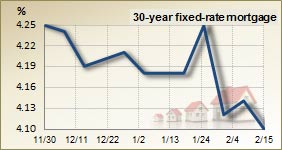
30 year fixed rate mortgage – 3 month trend
The benchmark 30-year fixed-rate mortgage fell 4 basis points this week to 4.1 percent, according to the Bankrate.com national survey of large lenders. A basis point is one-hundredth of 1 percentage point. The mortgages in this week's survey had an average total of 0.35 discount and origination points. One year ago, the mortgage index was 5.16 percent; four weeks ago, it was 4.18 percent.
The benchmark 15-year fixed-rate mortgage fell 1 basis point to 3.35 percent. The benchmark 5/1 adjustable-rate mortgage fell 2 basis points to 3.03 percent
This is the lowest the rate on the 30-year fixed has reached in the 26-year history of Bankrate's weekly rate survey. The previous record was 4.12 percent on Feb. 1.

Weekly national mortgage survey

Results of Bankrate.com's Feb. 15, 2012, weekly national survey of large lenders and the effect on monthly payments for a $165,000 loan:
30-year fixed15-year fixed5-year ARM
This week's rate:4.1%3.35%3.03%
Change from last week:-0.04-0.01-0.02
Monthly payment:$797.28$1,167.44$698.32
Change from last week:-$3.83-$0.80-$1.78


Recent economic reports show the economy is strengthening, and that's "supposed" to be pushing rates up, says Michael Becker, a mortgage banker at WCS Funding in Baltimore. "But Greece seems to be holding them down."

U.S. economy crawling toward recovery

Manufacturing figures released this week show production volume in U.S. factories increased in January and was better than expected in December. Production increased 0.7 percent in January and 1.5 percent in December, says the Federal Reserve. December was the month with the biggest growth in manufacturing in five years.


Read more: Mortgages Drop To New Record Low | Bankrate.com http://www.bankrate.com/finance/news/mortgages-drop-to-new-record-low.aspx#ixzz1ml2LfnvE

Thursday, February 16, 2012

Military gets foreclosure deal

Military gets foreclosure deal

By Polyana da Costa · Bankrate.com
Wednesday, February 15, 2012
Posted: 5 pm ET
Members of the military who were victims of wrongful foreclosures will receive substantial compensation from their mortgage servicers.
The U.S. Department of Justice has reached an agreement with four large lenders -- JPMorgan Chase, Wells Fargo, Citigroup and Ally Financial -- to provide "any service member who was a victim of a wrongful foreclosure a minimum payment of $116,785 plus the service member’s lost equity," says Assistant Attorney General Thomas E. Perez.
"To ensure consistency with an earlier private settlement, JP Morgan Chase will provide any service member who was a victim of a wrongful foreclosure either his or her home free and clear of any debt or the cash equivalent of the full value of the home at the time of sale," Perez said in a speech Friday.
The individual agreements are in addition to the $25 billion mortgage settlement announced last week.
Under the agreement, the lenders will review files dating back to Jan. 1, 2006, to determine whether any service members were foreclosed on in violation of the Servicemembers' Civil Relief Act, or SCRA. The act prohibits foreclosure on a service member's property without a court approval. When the servicer files a foreclosure suit in court, it is required to notify the court that the homeowner is on active duty. The act also specifies that a service member cannot be charged more than 6 percent in interest on a mortgage loan if the borrower is on active duty and requests a lower interest rate.
Citi, Wells and Ally also will review files going back to January 2008 to determine whether any service member was charged more than 6 percent in interest after requesting a lower rate. Those who had that right violated will receive three times what they paid in excess interest, or $500, whichever is larger. Chase has already compensated members through an earlier private settlement.
Now that is what I call a settlement. It's certainly much better than the mere $2,000 that nonmilitary borrowers may receive under the $25 billion federal-state mortgage settlement.
The Department of Justice says military members who are eligible for compensation will be contacted. Keep in mind it will take time to review files and identify eligible members. If you have questions, you may call the DOJ at (800) 896-7743.


Read more: Military members will get paid for wrongful foreclosures | Bankrate.com http://www.bankrate.com/financing/mortgages/military-gets-foreclosure-deal/#ixzz1maEIOtzf

Tuesday, February 14, 2012

Conventional, FHA, USDA... Oh MI!

Conventional, FHA, USDA...Oh MI!

Homebuyers often have a lot of questions about mortgage insurance (MI)...and understandably so. With different rules for different loan programs, the details can be confusing.

Here are a few things to keep in mind. All types of MI protect the lender in the event of default, and MI is typically required when homebuyers have less than a twenty percent deposit to put down on a home. There are two main types of MI: an Up Front Mortgage Insurance Premium (UFMIP), which is generally financed into the loan, and an additional monthly mortgage insurance premium (MIP), paid as a part of your normal monthly mortgage payment.

Here are some additional details to keep in mind:

CONVENTIONAL "MI"
FHA
"MIP"**
USDA "GUARANTEE FEE"
BasicsMI can be monthly or all up front1% UFMIP rolled into loan amount + Monthly Premium2% UF Guarantee Fee + Monthly Guarantee Fee
Potential BenefitsUpfront MI can save significantly on monthly payments.
Conventional MI often has lower monthly payments than FHA.
Income requirements are relaxed compared to conventional MI & USDA.
There is more flexibility in credit scores.

Seller paid closing costs is allowable up to 6%.
The monthly premium is typically almost 1/4 the cost of FHA.
Potential Pitfalls Seller paid closing costs is limited to 3% if ≤5% down payment.
Credit requirements and income requirements are more stringent.
The monthly premium is typically higher than conventional & USDA.There are specific geographic and income eligibility requirements. Income requirements are much more stringent than FHA.
Dropping MI When the value reaches 78% of the original sales price, MI automatically falls off.
You can request removal if the principal balance reaches 80% (i.e. accelerated payment of principal or, in some cases via an appraisal of the property showing increased value).
You must meet two tests to drop FHA's MIP:
1. You must PAY the balance down to 78% of the original sale price of the property (you can't just get an appraisal to show equity).
AND
2. You must pay the monthly MIP for a minimum of 5 years.
The USDA Guarantee Fee remains on the loan for the entire term. It can never be dropped from a USDA loan until the property is sold, refinanced or the loan is paid off.
** Note that the FHA MIP example is based on a 30 year example.

If you have any questions about mortgage insurance or anything at all, call me or email me anytime. I’m always happy to help.

Sincerely,

Bryant L. Grantham
Your Mortgage Professional